
Living Wills
The Advanced Medical Directives Act passed in April 2026

Living Wills
The Living Will, what is it?
An Advance Directive, commonly known as a Living Will, records, in advance, a person’s decisions about their future healthcare, to be respected if they later become unable to communicate their wishes. It reflects the long-established right of a patient to consent to, or deny, medical treatment, and ensures their autonomous voice remains central in decisions affecting their own body and life.
Legislation In Malta
New legislation will enable legally-binding Living Wills to be made in Malta. It reflects much, but not all, of the thinking in our Discussion Paper, which we published in 2022, on the introduction of the legally-enforceable Living Wills.
The core purpose is to express decisions made calmly by a fully-informed person, in advance of any medical crisis. It:
- ensures a patient’s wishes can’t be overridden when they are unable to speak for themselves;
- provides clarity for families facing difficult and emotionally-fraught decisions; and
- gives healthcare professionals legal protection when acting in accordance with a patient’s stated wishes, and guidance when faced with complex medical decisions.
People’s views on such matters can vary greatly. Some may wish for every possible medical intervention to prolong life, regardless of the prospects of recovery. Some may want doctors to make all treatment decisions on their behalf. And some may prefer to refuse certain treatments, based on their own values and understanding of dignity and quality of life.
The Advance Medical Directives Act
The Act was passed on 24 April 2026. It provides a framework for mentally competent adults aged 18 and over to state, in advance, their legally-binding wishes about medical treatment. The Act will not enter into force until a ministerial order (or orders) is made after administrative and regulatory structures are established.
Under the Act:
- directives will apply only when the individual is unable to communicate their wishes at the time;
- individuals can refuse extraordinary medical interventions, such as CPR, artificial ventilation, artificial hydration, or artificial feeding, if there is no reasonable prospect of recovery;
- individuals can’t refuse basic medical or palliative care designed to ease pain and suffering;
- individuals can’t request assisted dying;
- to be legally binding, a Living Will must be written after medical advice, and formalised by a notary;
- a Living Will can be amended or revoked at any time; and
- a Living Will is entered into the individual’s medical records to ensure the healthcare team is aware of it.
Health Care Proxy
It’s disappointing to Humanists Malta that the Act doesn’t provide for a health care proxy, enabling an appointed person to make health care decisions on an individual’s behalf in unforeseen circumstances when they are no longer capable of doing so.
Living Wills Made Before The Act Will Not Enter Into Force Automatically
They will not be legally binding unless they are re-stated in accordance with the Act.
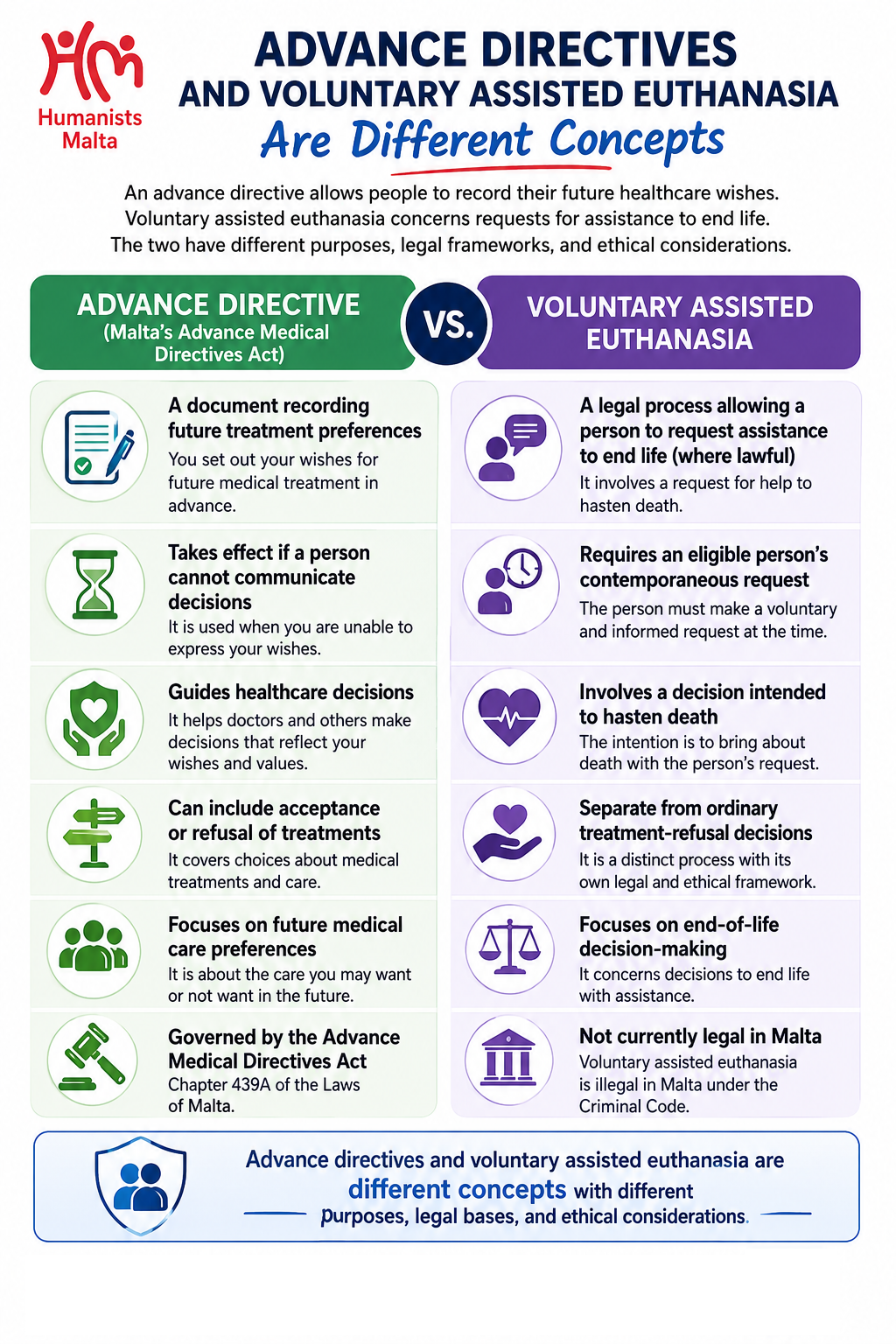
Living Wills and Voluntary Assisted Euthanasia Are Distinct And Unrelated
Although the Government first addressed the concept of Living Wills in its consultation document last year on Voluntary Assisted Euthanasia, it’s important to emphasise that the two issues are distinct. A Living Will isn’t about euthanasia, nor solely for those approaching the end of life. (See infographic).
Is There A Required Format?
Whilst the Act doesn’t prescribe the format of a Living Will, it provides a model which could be helpful. Below, you will find an outline of that model form:
———————————————————-
A Possible Living Will (see the Schedule to the Act https://parlament.mt/media/138438/act-xii-advance-medical-directives.pdf )
I – Full identifying details of the individual, and declaration that they’re making the Advance Medical Directive freely, voluntarily, and after receipt of adequate medical information.
II – Declarations that they:
- have discussed their directive with a medical practitioner;
- have been clearly informed of the nature and consequences of their refusals; and
- understand that the directive applies only if, at the material time, they lack capacity to give or refuse consent.
III – Confirmation that their directive shall apply only in certain situations, choosing between any or all of:
- terminal illness with no reasonable prospect of recovery;
- permanent unconsciousness, persistent vegetative state, or minimally conscious state with no reasonable prospect of recovery;
- advanced, irreversible condition resulting in total dependency and severe suffering with no prospect of meaningful improvement.
IV – In the circumstances in Part III, they refuse any specified, or all, of the following:
- Cardiopulmonary resuscitation (CPR);
- Mechanical ventilation;
- Artificial nutrition;
- Artificial hydration;
- Renal replacement therapy (dialysis);
- Antibiotic treatment primarily aimed at prolonging life;
- Any other specified treatment.
And confirm they understand that refusal of the specified treatments may result in their death.
V – Notwithstanding any refusal of medical treatment expressed in the directive, they instruct that appropriate palliative and comfort care shall always be provided, in accordance with established medical standards. Treatment for alleviation of pain, suffering, breathlessness, anxiety or any other discomfort shall be provided, even if it may incidentally shorten their life.
VI – Confirmation they understand that:
- they may revoke or amend the directive at any time while they have capacity;
- any oral revocation in the presence of a medical practitioner and at least one witness shall be valid;
- any subsequent conduct clearly inconsistent with their directive may affect its validity or applicability.
VII – Identifying details of the relevant medical practitioner, with certification that they:
- have discussed advanced medical planning with the individual; and
- are of the opinion that the individual demonstrated capacity at the time of signing the directive and demonstrated understanding of the nature and consequences of their refusals.
VIII – Declaration before a notary
IX – Identifying details of, and authentication by, the relevant notary

